
Europe
Loading...

Data centres are worthy of all the buzz given their role in helping the global economy turn digital. Their network and storage infrastructure and compute capabilities are the backbone of advancing technologies like artificial intelligence (AI), cloud computing, and cryptocurrency mining, among others. The proliferation of these technologies comes with an energy cost, though. Accompanying data centres’ growth is an exponential increase in the energy that they consume, creating an urgent need for sustainable solutions to alleviate pressure on already strained energy resources. For investors, renewable energy alternatives offer compelling exposure to growth opportunities, and the burgeoning data centre industry is one that could help accelerate their adoption.
Data centre electricity usage is poised to double as soon as 2026 due to the surge in power-intensive technologies like AI, cloud computing, the internet-of things, and cryptocurrency mining.2 On a global scale, data centres consume roughly 200 terawatt-hours (TWh) of energy each year, with the top three hyperscalers, Amazon, Microsoft, and Google, responsible for approximately 90 TWh of the consumption.3 That figure is likely to grow significantly with the full implementation of AI in search tools like Google, perhaps by as much as tenfold.4 The energy requirements of a typical Google search is 0.3 watt-hours (Wh), while a request made to OpenAI’s ChatGPT is 2.9 Wh. Considering that there are approximately 9 billion daily searches translates to additional electricity demand of nearly 10 TWh annually.5
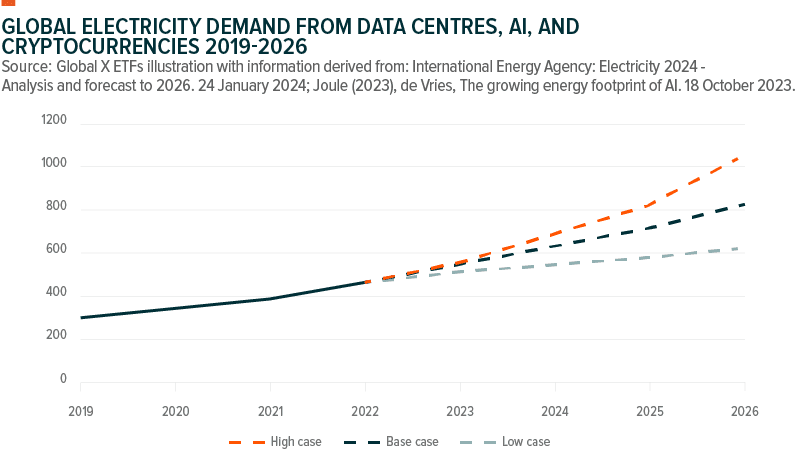
According to the International Energy Agency’s (IEA) 2024 annual electricity report, data centres consumed 460 TWh in 2022, a figure that could soar to 650 TWh in a best-case scenario to over 1,000 TWh by 2026 in a worst-case scenario.6 The rapid expansion of AI-related services driving investments in power-hungry GPUs is likely to increase usage. For example, Nvidia, the dominant player in the AI server market with an estimated 95% market share, has become the primary beneficiary of the demand for computing power to support AI projects.7 In January, Meta Platforms Inc revealed that it intends to buy more than 350,000 of Nvidia’s H100 GPU’s by end of the year.8 The enormous demand is further reflected in Nvidia’s Data Centre segment recording a record $47.5bn in FY2024 revenue, a 217% increase from a year ago.9
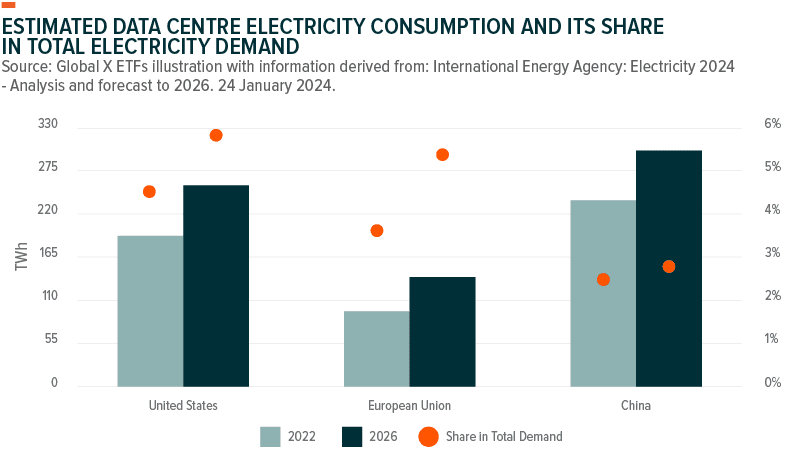
In the United States, which accounts for 33% of the world’s data centres, energy consumption is anticipated to total 260 TWh in 2026, representing approximately 6% of the country’s electricity consumption.10 Available data from Europe shows that in 2018 data centres consumed 76.8 TWh.11 That number is expected to increase by 28% to 98.5 TWh by 2030 and reach 3.21% of total electricity consumption.12
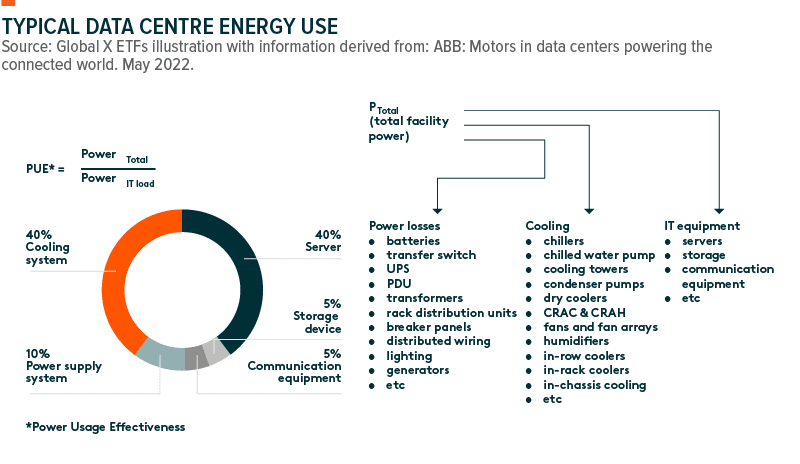
Data centres’ electricity consumption primarily stems from computing and cooling systems. Computing constitutes approximately 40% of the total electricity demand, and the cooling systems required to maintain optimal processing efficiency account for another 40%.13 The remaining 20% of electricity usage is attributed to other ancillary IT equipment.
Escalating global data centre energy consumption makes innovation critical to mitigate environmental impacts and ensure sustainability. Renewable energy sources like solar and wind power can help flatten energy consumption profiles and reduce dependence on non-renewable sources, particularly during peak-demand periods.14 Energy storage and battery technologies will be critical in facilitating efficient management of renewable energy supplies, ensuring uninterrupted operations.15
Digital Realty, one of the largest providers of cloud and carrier-neutral data centres, colocation, and interconnection solutions is revolutionizing sustainable data centre solutions and setting new industry standards. The company recently surpassed 1 gigawatt (GW) of sustainable IT capacity, boasting global renewable energy coverage of 64%.16 The company, which has partnerships with industry leaders such as Nvidia and Schneider Electric to propel AI and sustainability initiatives, aims to extend its deployment of renewable energy generators in the United States and globally.17 Also, the company leads initiatives like the EU Climate Neutral Data Centre Operator Pact, advocating for industry-wide sustainability standards.18
Equinix is regarded as another leader in this field, demonstrating its commitment to green energy integration through strategic partnerships and ground-breaking initiatives. In January 2024, the company signed one of the largest power purchase agreement (PPA) deals in France’s history. This 20-year PPA with renewable energy producer wpd will procure energy from a wind farm to help power its data centres.19
Technological advancements, especially in efficiency, and updated regulations to keep companies in line are essential to manage the surge in data centre energy consumption. Regulatory scrutiny on data centres’ energy consumption is starting to intensify with governments imposing stringent mandates.
In March 2024, the EU Commission approved a new Energy Efficiency Directive that introduces a unified scheme to assess the sustainability of data centres with a power demand of 0.5 megawatts (MW) or higher.20 Beginning in 2026, data centre operators must report sustainability metrics, including total electricity usage and the proportion covered by renewable sources. The objective is to facilitate comparisons among data centres and encourage the implementation of innovative designs or suitable efficiency measures in new and existing facilities. These measures aim to significantly decrease energy and water consumption and encourage the adoption of renewable energy sources, enhance grid efficiency, and facilitate the reuse of waste heat in adjacent facilities and district heating networks.
New regulations at the country level are a trend as well. In late 2023, Germany implemented a new Energy Efficiency Act, stipulating that data centre operators source 50% of their electricity from non-subsidised renewable sources by January 2024 and 100% by January 2027.21
As the digital landscape expands at an exponential pace, so does data centres’ energy consumption. It is believed that the data centre industry’s willingness to embrace new technologies that reduce strain on energy grids positions it as a proactive contributor to the solution. Given the industry’s essential role in turning the world digital, green data centres could be another major driving force in the transition to renewables, and one that creates compelling investment opportunities along the way.
1. Arthur D Little, Green Data Centers: Opportunities for decarbonization. September 2023.
2. International Energy Agency: Electricity 2024 - Analysis and forecast to 2026. 24 January 2024.
3. Arthur D Little, Green Data Centers: Opportunities for decarbonization. September 2023.
4. International Energy Agency: Electricity 2024 - Analysis and forecast to 2026. 24 January 2024.
5. Ibid.
6. Ibid.
7. Wheatley, M., Silicon Angle, Nvidia’s data center GPU sales grow by stunning 40(% on huge demand for AI chips. 21 February 2024.
8. Ibid.
9. Nvidia Newsroom. Nvidia announces financial results for fourth quarter and fiscal 2024. 21 February, 2024.
10. DataCenterDynamics, Global data center electricity use to double by 2026. 26 January 2024.
11. European Commission. Commission takes first step towards establishing an EU-wide scheme for rating sustainability of data centres. 12 December 2023.
12. Ibid.
13. ABB Motors in data centers: Powering the connected world. May 2022.
14. Arthur D Little, Green Data Centers: Opportunities for decarbonization. September 2023.
15. Ibid.
16. Digital Realty. Digital Realty Becomes First Data Center Operator to Reach One Gigawatt of IT Capacity of Sustainable Building Certifications. 29 June 2022.
17. DataCentre Magazine, A. Jackson, Digital Realty Continues Renewable Rollout to the US. 12 April 2024.
18. Schneider Electric, Digital Realty: Leading Sustainable Initiatives Across EMEA. 6 March 2022.
19. DataCenterDynamics, Equinix signs wind PPA in France with wpd. 1 February 2024.
20. European Commission, Data centres in Europe – reporting scheme. 14 March 2024.
21. European Commission. Energy Efficiency Directive. Revision entered into force on 10 October 2023.
